
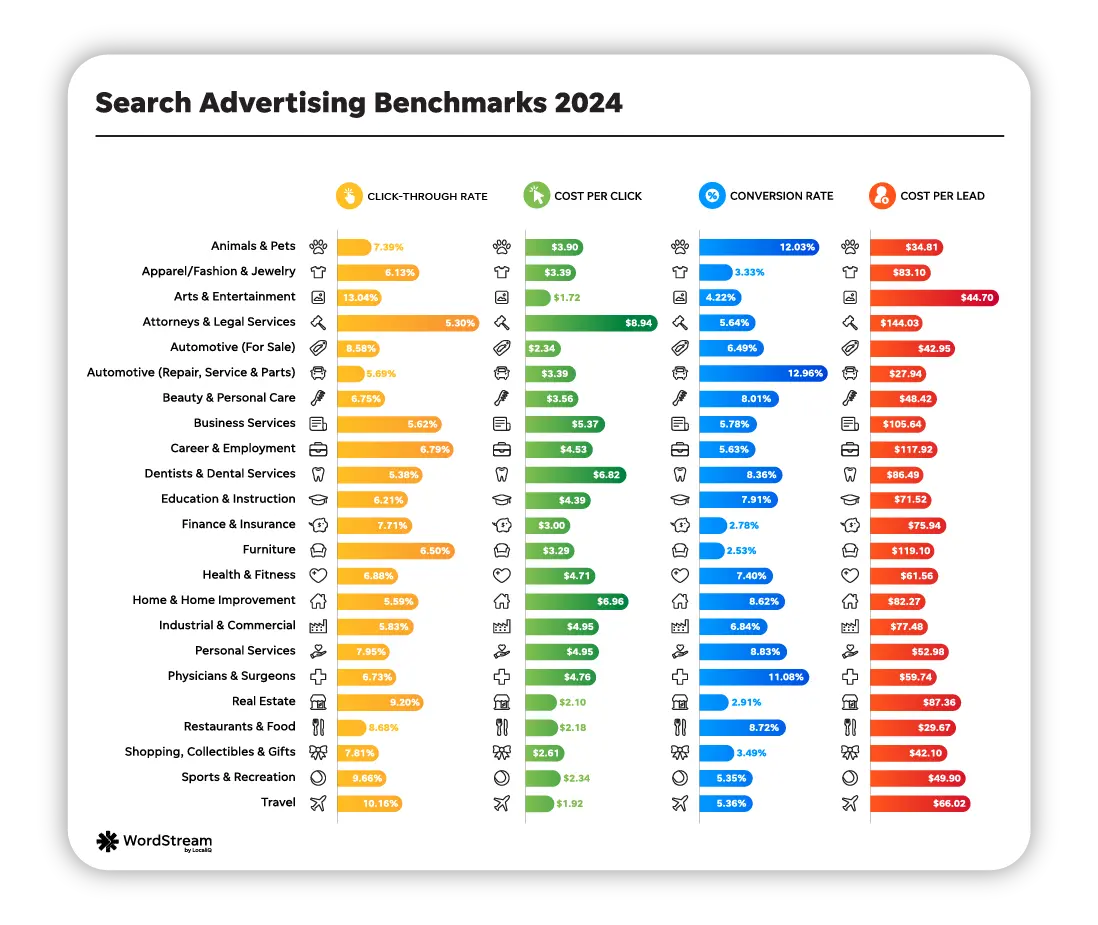
In 2025, the average cost per conversion (CPA) for Google Ads across all industries in Google Search is around $48.96 USD, with the median cost per conversion for Google Ads campaigns run by marketing agencies being $34.61.
Here’s a more detailed breakdown:
Average CPA (Cost Per Acquisition):
- The average cost per conversion across all industries in Google Search is $48.96.
- Median Cost Per Conversion for Agency Campaigns:
- Marketing agencies typically see a median average cost per conversion of $34.61.
Conversion Rate:
- The median conversion rate achieved by agencies across all industries is 4.61%.
Average Cost Per Click (CPC):
- The median average cost per click (CPC) for Google Ads campaigns run by marketing agencies is $1.79.
Other benchmarks:
- Click-through rate: 6.11%
- Cost per lead: $53.52
- Average ecommerce conversion rate for Search Ads: 2.81%
- For Display Ads, the average conversion rate is: 0.59%
In Canada, the average cost per click (CPC) for Google Ads is around $1.23, with businesses spending between $100 and $10,000 per month, and the average conversion rate is around 3.75% for search and 0.77% for display
How to increase Google Ads conversion rate & reduce CPA?
Several optimisation initiatives can be taken to boost Google Ads conversion rate and CPA. Check out the list below.
It is essential to identify the correlations between your conversion rate performance metrics before working on improving the conversion rates and reducing the CPA.
- Keyword optimisation: Bidding on selected and long tail keywords is the gest way to optimise the budget to get lower cost per acquisition. If you have a decent budget then you may consider a broader range of keywords including some generics to boost conversion rate but they may increase the CPA also.
- Ad Refinement: Think outside the box. Attention-grabbing headlines and clear call-to-actions increase the likelihood of the lead taking the desired action. The product or service description should be very clear.
- Ad Copy: Multiple ad copy variations could be an added advantage. Google’s Responsive Search Ads offer flexibility in headlines and description variations that are optimised by machine learning.
- Fine-tuning the CTAs: Evaluate the call to action throughout your conversion funnel to persuade every visitor to the landing page to take the desired action.
- User Experience: Ensure the customer’s journey from search to ads to landing page is fully optimised. Gather customer insight data to identify their key touchpoints, pain points, and drop-off points. Accordingly, add offers to your top or middle funnel.
- Landing Pages: A trustworthy, user-friendly landing page encourages conversion.
- A/B Testing: Conduct A/B tests to identify high-performing elements of the ads. Implement successful variations to improve conversion rates.
- Target Audience: Refine your audience targeting based on demographics, interests, and behavioural patterns to make traffic more likely to convert. Implement remarketing strategies to re-engage the warm or cold traffic.
- Bidding Strategies: Automated bidding strategies can maximize conversions but in some cases, manual CPC works really well, for example, branding campaigns.
- Timing: Identify peak conversion times and adjust your ad scheduling accordingly when the target audience is most active.
- Trust and Credibility: Building a strong reputation for the brand is very essential. Secure transactions, customer testimonials, and timely responses to customer queries are very important to building a trustworthy landing page. This, in turn, increases the likelihood of conversion.
- Ad Funnel: A cohesive funnel ensures that, right from awareness to final conversion, every stage of the funnel flows seamlessly with tailored messages and a smooth user experience, guiding customers towards a long-term relationship with the brand.
Click here to add your own text
